Rooted in Concrete: Building a Faith That Actually Fits the City
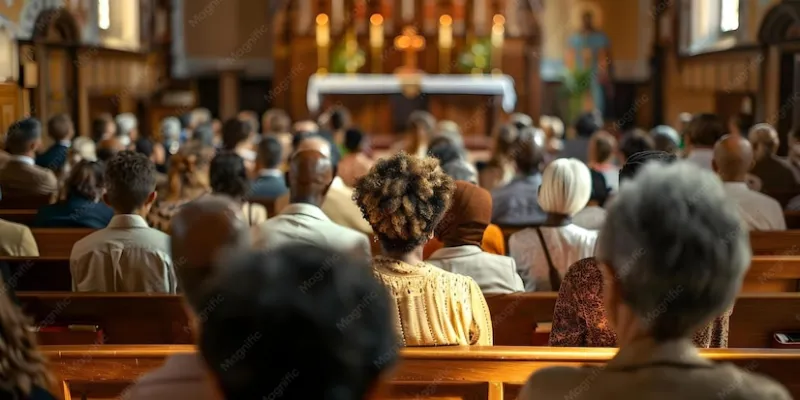
Photo: diverse urban congregation community gathering city church neighborhood, via img.freepik.com
There is a particular kind of loneliness that cities manufacture at scale. You can ride a crowded subway car for forty minutes, pressed shoulder to shoulder with dozens of strangers, and arrive at your destination having made no human contact whatsoever. You can live in an apartment building for three years without learning a single neighbor's name. You can attend a church of four hundred people and feel, week after week, profoundly unseen.
This is not a failure of character. It is, in many ways, a structural feature of dense urban life—one that most inherited models of Christian community were never designed to address. The small-group ministry developed for a homogeneous suburban congregation, the stewardship campaign premised on stable homeownership, the pastoral care model that assumes a pastor can visit families in their homes: these approaches were built for a different geography, a different economy, and a different social architecture.
For urban Christians navigating the particular pressures of city life, the gap between what their faith tradition offers and what their daily context demands can be quietly devastating.
The Mismatch Between Inherited Models and Urban Reality
The dominant strands of American Protestant Christianity took their modern shape in the mid-twentieth century, during the era of suburban expansion. Congregational models, programming rhythms, and even architectural assumptions were calibrated to the realities of car culture, nuclear family households, and racially homogeneous neighborhoods. The megachurch, the small-group movement, the seeker-sensitive service—each emerged from and was refined within that context.
Urban environments operate by entirely different rules. Household structures are more varied: single adults, multigenerational immigrant families, roommate configurations born of economic necessity. Schedules are less predictable, governed by shift work, long commutes, and the relentless pace that cities impose. Neighborhoods can change their demographic character within a decade, raising urgent questions about belonging, displacement, and who the church is actually for.
Dr. Yolanda Ferris, a practical theologian at a seminary in New York City, puts it plainly: "When you import a model designed for Naperville into the South Bronx, you are not just dealing with a logistical mismatch. You are dealing with a theological one. The assumptions embedded in that model—about family, property, stability, homogeneity—are themselves value-laden. And many of those values are in tension with the Gospel when you examine them honestly."
What a Theology of the City Actually Requires
The concept of an urban theology is not new. Thinkers from Harvey Cox to Harvie Conn to Willie James Jennings have argued that the city is not merely a backdrop for ministry but a theological subject in its own right—a place that Scripture takes seriously, that God inhabits, and that demands particular forms of witness.
Jennings, whose work on Christian identity and displacement has become increasingly influential in urban ministry circles, argues that one of Western Christianity's deepest failures has been its difficulty forming genuine community across lines of difference. The city, with its enforced proximity to the other—the neighbor of a different language, economic class, or immigration status—is precisely the space where that failure becomes most visible and most costly.
A theology adequate to the city, then, must begin with an honest reckoning with difference. Not the managed diversity of a carefully curated worship team, but the disorienting, demanding encounter with actual neighbors whose lives and needs are radically unlike one's own.
"The city is a spiritual laboratory," says Rev. James Whitfield, who planted a congregation in a rapidly gentrifying neighborhood in Atlanta. "Every Sunday, I look out at a room that contains people whose rent has tripled in five years and people whose property values have soared. Those are not abstract social forces. Those are my people, sitting next to each other, trying to worship the same God. That tension is not a problem to be managed. It is the curriculum."
Practical Realities: Isolation, Displacement, and Demographic Change
For urban congregations, three challenges recur with particular intensity.
Isolation amid density demands that churches invest in structures of genuine, sustained relationship rather than programmatic connection. Many urban congregations are experimenting with hyper-local models—neighborhood-based home gatherings, block-level pastoral care, partnerships with apartment building management to create community programming—that build the kind of durable human contact that city life tends to erode.
Economic disparity within neighborhoods raises uncomfortable questions about whose interests the church serves. When a congregation's membership spans multiple income levels, and when local policy decisions affect those members in diametrically opposite ways, the church cannot remain neutral without, in effect, siding with the more powerful. Several urban congregations have addressed this by developing explicit economic solidarity practices: shared emergency funds, employment networks, advocacy on tenant protection legislation.
Rapid demographic change—often driven by gentrification—confronts churches with a choice about identity and loyalty. Is the congregation rooted in a neighborhood, or in a demographic? When longtime residents are displaced by rising costs, does the church move with its original members, stay and welcome newcomers, or find ways to resist the displacement itself? These are not rhetorical questions. They are decisions with real consequences for real people, and they require theological clarity to navigate faithfully.
Formation for a Different Kind of Witness
What emerges from conversations with urban ministry practitioners is a vision of spiritual formation that is less focused on individual piety and more attentive to communal solidarity. The practices that seem most generative in city contexts tend to share certain features: they are rooted in specific places rather than abstract principles; they require ongoing relationship with people unlike oneself; and they hold together contemplation and action without treating them as separate domains.
Liturgical practices have also been reimagined. Some congregations have incorporated neighborhood walks—prayerful attention to the built environment, the businesses, the vacant lots, the murals—as a form of corporate worship. Others have developed rituals of lament that name specifically the losses their neighborhoods have sustained: the community center that closed, the family that was evicted, the language that is disappearing from the block.
These are not novelties for novelty's sake. They are attempts to take seriously the theological claim that God is present in the city—not despite its chaos and pain, but within it.
An Invitation to Theological Seriousness
For urban Christians who have felt the quiet dissonance of trying to inhabit a faith that does not quite fit their lives, the invitation here is not to abandon inherited tradition but to bring that tradition into honest conversation with their actual context. The resources are there—in Scripture, in the history of urban Christian witness, in the theology emerging from communities who have long had to make their faith work in hard places.
The city is not a problem to be solved by the right ministry model. It is a place of profound human longing and divine presence, demanding a faith that is, above all else, genuinely alive to where it finds itself.