Holding Faith and Conviction Together: Navigating Political Differences Inside Your Congregation
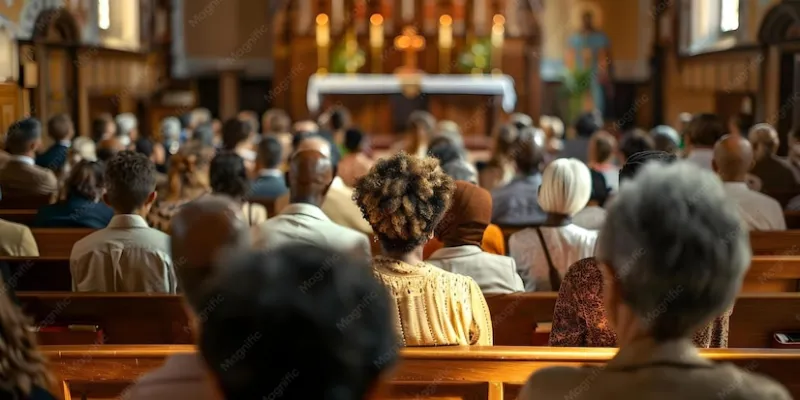
Photo: diverse urban congregation discussing community meeting church, via img.freepik.com
When the Body of Christ Feels Divided
There is a particular kind of loneliness that settles in when you look around your congregation and realize that the people you worship beside—people you love, people who have held your hand through grief and celebrated your children's baptisms—hold political convictions that feel, to you, not merely different but morally incompatible with the Gospel you share.
This is not a hypothetical tension. It is the lived reality of millions of urban Christians across the United States today. In cities like Chicago, Atlanta, Philadelphia, and Los Angeles, metropolitan congregations draw together people from wildly divergent economic backgrounds, immigration histories, and political orientations. The richness of that diversity is precisely what makes the urban church one of the most vital expressions of Christian community in America. It is also what makes it one of the most combustible.
The question before us is not whether these tensions will arise. They will. The question is whether our communities have the theological maturity and relational depth to hold them without fracturing.
Understanding the Roots of Political Disagreement in the Pew
Before we can navigate disagreement well, we must understand it honestly. Political conflict within congregations rarely emerges from bad faith. More often, it reflects genuine differences in how people interpret the same scriptural commitments through the filter of their own experiences.
Consider housing justice, one of the most pressing issues facing urban communities today. Two members of the same congregation—one a longtime homeowner whose neighborhood has gentrified around her, another a renter facing displacement—may read the same passage from Leviticus about fair treatment of the stranger and arrive at profoundly different policy conclusions. Neither is reading carelessly. Both are reading through the lens of a life the other has not lived.
Recognizing this does not require abandoning the pursuit of moral clarity. It does require cultivating what theologians sometimes call epistemic humility—the willingness to acknowledge that our understanding of God's will is always partial, always mediated through our particular vantage point in the world.
Practical Frameworks for Faithful Disagreement
Start with Shared Commitments, Not Contested Conclusions
One of the most effective approaches used by pastors and lay leaders in diverse urban congregations is to anchor civic conversations in shared theological values before moving toward policy specifics. At Covenant Community Church in Detroit, for example, small group facilitators begin politically sensitive discussions by asking participants to articulate what they believe Scripture calls the church to care about—dignity, justice, mercy, the flourishing of the vulnerable—before any specific legislation or candidate is mentioned.
This is not a strategy for avoiding hard conversations. It is a method of ensuring those conversations happen on ground where genuine common cause already exists. When participants discover that they share a deep commitment to the wellbeing of unhoused neighbors, the disagreement about how to address homelessness becomes a substantive debate between people who trust each other's intentions, rather than a proxy war between ideological enemies.
Distinguish Between Witness and Partisanship
The church has always had a prophetic role in public life. From the abolitionist movement to the civil rights era, American Christianity's most transformative contributions to democracy have come when congregations were willing to speak with moral clarity about injustice. That tradition is not partisanship—it is discipleship.
The distinction matters enormously within congregations navigating political diversity. Affirming the dignity of immigrants, demanding accountability for police violence, or advocating for living wages are not inherently partisan positions; they are applications of Gospel principles that people across the political spectrum can, and do, hold. Framing civic engagement in terms of witness rather than party affiliation creates more room for broad participation and less incentive for members to experience the church's public voice as a tribal loyalty test.
Create Structured Space for Honest Dialogue
At St. Philip's Episcopal in Harlem, the rector introduced what she calls "Faithful Disagreement Forums"—quarterly gatherings where congregants are invited to discuss a pressing civic issue under a set of explicitly Christian conversational norms: speak from personal experience, listen to understand rather than to respond, and end with prayer. The format has not eliminated disagreement. It has transformed the quality of disagreement, moving it from social media hostility to face-to-face accountability.
Other congregations have found success with structured listening circles, paired conversations between members who hold different views, and pastoral-led Bible studies that intentionally engage politically complex texts without prescribing conclusions.
The Cost of Avoiding the Conversation
It would be dishonest to suggest that all political tensions within the church are equally resolvable, or that maintaining community never requires a cost. There are moments when a congregation's silence on a justice issue—or its active opposition to one—becomes a source of genuine spiritual harm for members who belong to communities directly affected by that issue.
Several LGBTQ-affirming Christians in non-affirming congregations, Black members of predominantly white churches navigating racial justice debates, and immigrant parishioners in congregations that have been silent on immigration policy all describe a version of the same experience: the exhaustion of being asked to set aside their full humanity in order to preserve a peace that primarily benefits those who are not at risk.
Faith communities must reckon honestly with this asymmetry. The burden of "keeping the peace" is not distributed equally across a congregation. Pastoral leadership that centers unity without attending to who is being asked to bear the cost of that unity is not, in fact, neutral. It is a choice—and one with moral consequences.
Finding Your Place Without Losing Your People
For individual Christians navigating this terrain, a few orienting principles may prove useful.
First, invest relationally before you engage politically. The conversations that survive political disagreement are almost always the ones built on genuine friendship. Know your neighbor's story before you challenge their position.
Second, be honest about your own formation. Our political convictions are not purely rational conclusions; they are shaped by our families, our neighborhoods, our economic situations, and our experiences of harm or privilege. Owning that honestly makes us better dialogue partners.
Third, know when to speak and when to act. Sometimes the most faithful thing you can do within a congregation that is not yet where you believe it should be is to quietly, persistently, demonstrate the alternative—through the relationships you build, the causes you champion, the grace you extend to those who disagree with you.
The metropolitan church is, at its best, a community that refuses the easy comfort of ideological homogeneity in favor of the harder, richer work of genuine encounter. That work is never finished. But it is, we believe, among the most important work the church can do.